Ring5 Resonator
Ring5 is a Rack Extension for Reason DAW
Based on Mutable Instruments’ Rings eurorack module, Ring5 modal resonator is a faithful port of Emilie Gillet’s original source code, rehoused as a reason-native Rack Extension that feels at home next to stock devices.
https://www.reasonstudios.com/shop/rack-extension/ring5/
Available October 20th, 2026
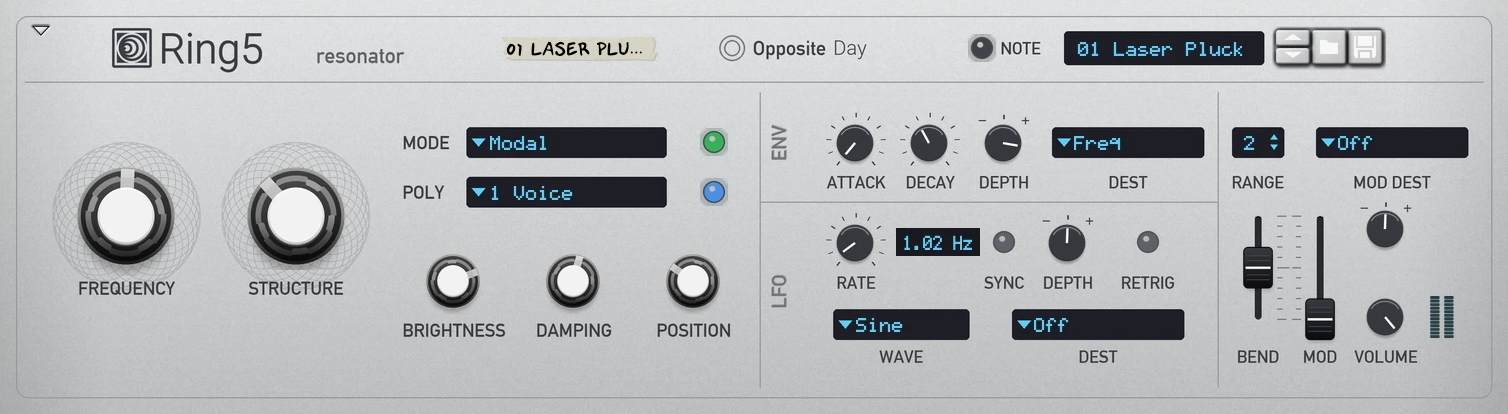

Sound engine
Faithful Rings DSP. A native Reason port of Mutable Instruments Rings, using the same DSP and the same controls. The original code is open source under the MIT license, and the attribution is printed on the back panel.
Ten resonator models. Three classic Rings models (Modal, Sympathetic, Inharmonic), three hidden modes (FM Voice, Quantized, Reverb String), and four “Disastrous Peace” string-synth modes (Syn Formant, Syn Chorus, Syn Ensemble, Syn Reverb).
Four shaping knobs. Structure, Brightness, Damping and Position.
Knob labels follow the model. For example, RATIO / INDEX / FEEDBACK in FM Voice, CHORD in Quantized, and CHORD / HARMONICS / ENVELOPE / FX in the string-synth modes.
Click-free model switching. Moving between a resonator model and a string-synth model fades out and back in.
Playing it
Plays from MIDI. Each note sets the pitch and strums a new voice.
Automatic chord strumming. Play a chord and Ring5 strums it, releasing the notes a few milliseconds apart, one per voice.
Pitch bend. A BEND wheel follows the keyboard’s pitch wheel. RANGE sets the bend from 0 to 24 semitones (default 2).
Mod wheel. A MOD wheel follows the keyboard’s mod wheel. MOD DEST routes it to Freq, Structure, Brightness, Damping, Position or FM, and a bipolar amount knob sets depth and direction.
Modulation
AD envelope. Retriggered by every note-on and shared by all voices. Attack runs from 1 ms to 2 s and Decay from 2 ms to 8 s, and a new note restarts from the current level, so fast playing doesn’t click.
LFO. Five waves: Sine, Triangle, Saw, Square and Random. The rate runs from 0.02 to 20 Hz and is shown on a live readout.
Tempo sync. Locks the LFO to Reason’s transport, with note values from 16/4 to 1/32, including 1/8T. RETRIG restarts the cycle on each note when the LFO runs free.
Effect use and CV
Use it as an effect. Stereo AUDIO IN, summed to mono, replaces the built-in exciter. Sharp transients in the incoming audio strum new voices.
Built-in exciter. When nothing is patched into AUDIO IN, every strum fires a filtered pulse or a noise burst, depending on the model.
Note CV and gate inputs. V/OCT overrides the MIDI pitch, and STRUM takes a gate.
Five modulation CV inputs. FM, Structure, Brightness, Damping and Position, each with a standard Reason trim knob.
Four CV outputs. Two LFO outputs, an inverted LFO output, and an envelope output. They carry the raw signals, unaffected by DEPTH and DEST.
ODD / EVEN stereo outputs. With one voice they carry two complementary parts of the sound. With more voices they split odd- and even-numbered voices.
In Reason
38 factory patches. Spread across 8 categories, with full browse and save.
Automation, Remote and MIDI CC. Every front-panel control can be automated and mapped with Remote, including Edit Remote Override Mapping. MIDI CCs 71–76 and 80–92 cover every control except Mode and Poly.